
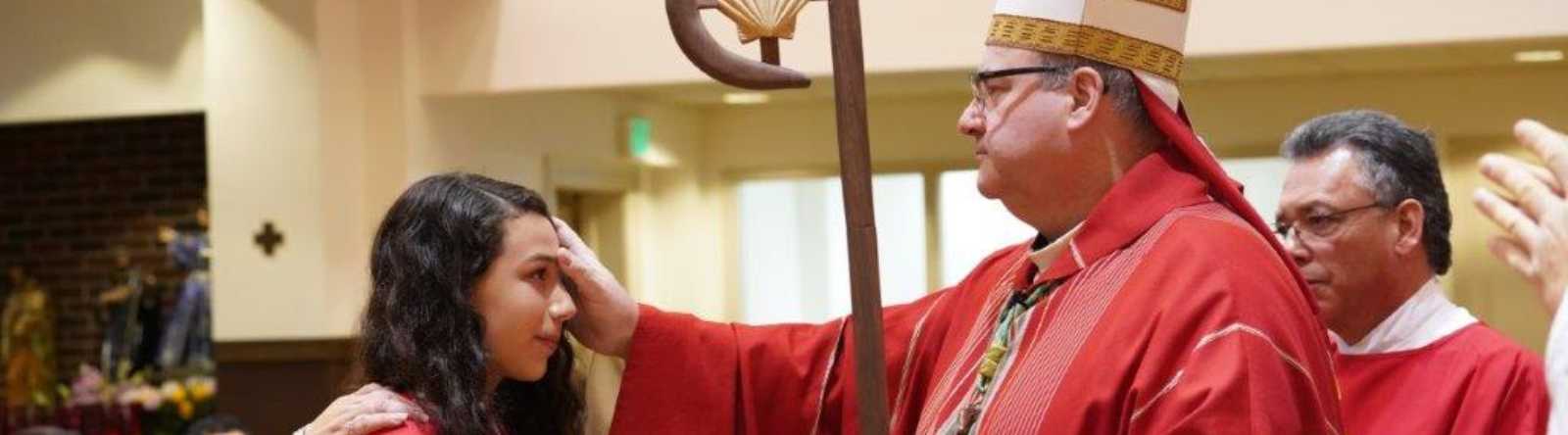

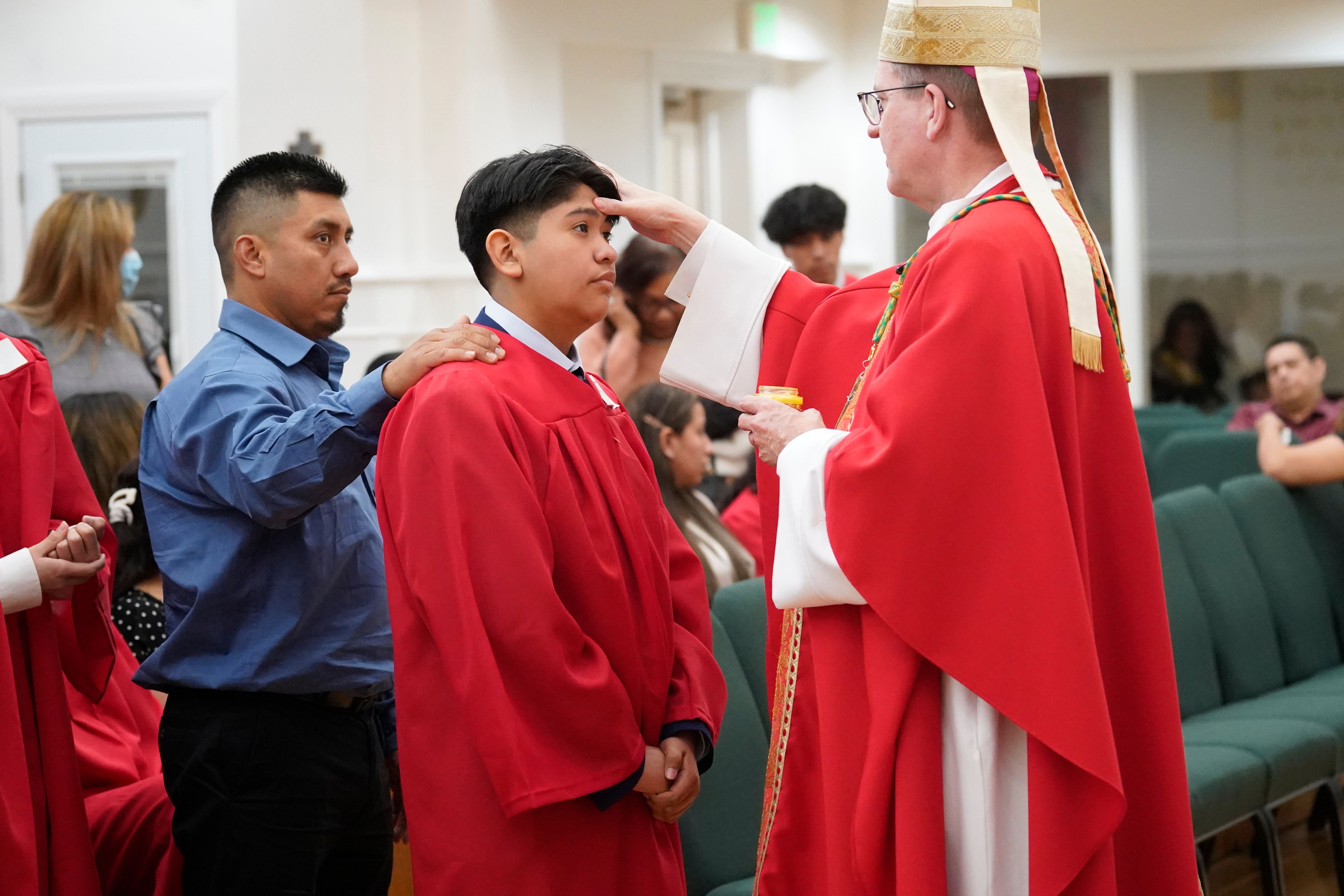
The Sacrament of Confirmation enables the baptized person to be enriched with a special strength of the Holy Spirit and unites them to the Catholic Church to become true witnesses of Jesus Christ.
El Sacramento de la Confirmación hace posible que los bautizados sean enriquecidos con la fuerza del Espíritu Santo que los une a la Iglesia Católica haciendolos auténticos testigos de Jesús.
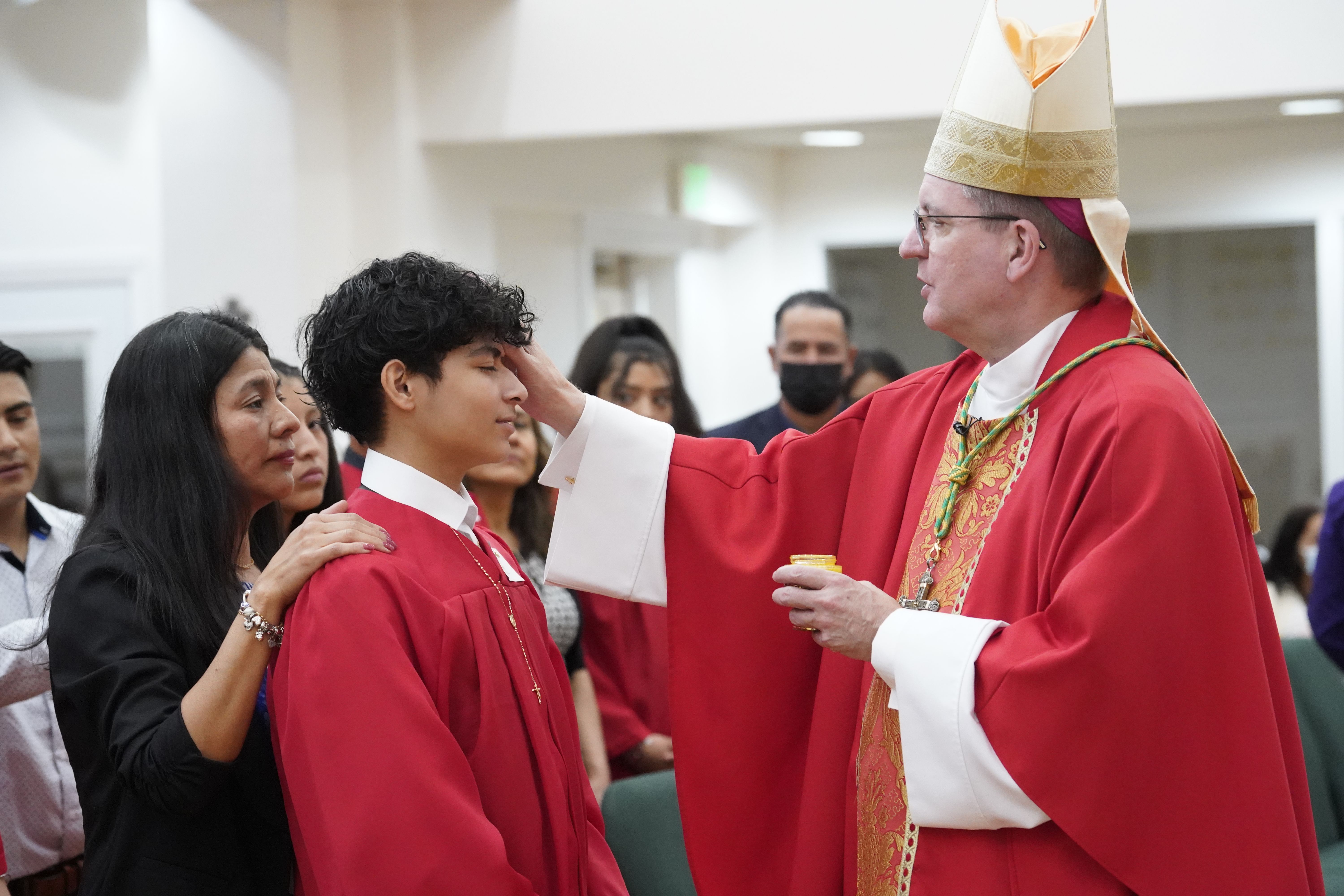
The effects of Confirmation enables us to be more united to Jesus Christ, increases the gifts of the Holy Spirit within us, and deepens our involvement in the Catholic Church.
Los efectos de la Confirmación nos abilita para estar mas unidos a Jesucristo dónde los dones del Espíritu Santo en nosotros se acrecientan y nuestra identidad de católicos es mas evidente.
Normally children are confirmed in 8th Grade. Please visit the Religious Education for more information about our program.
Usualmente el sacramento de la Confirmación se recibe en el octavo grado. Favor de consultar la seccion Religious Education para mas información de nuestro programa.
Adults who have not been confirmed may inquire about the process to be received in the Catholic Church through RCIA / RICA.
Los adultos que deseen ser confirmados pueden pedir información para éste proceso de RICA / RCIA.
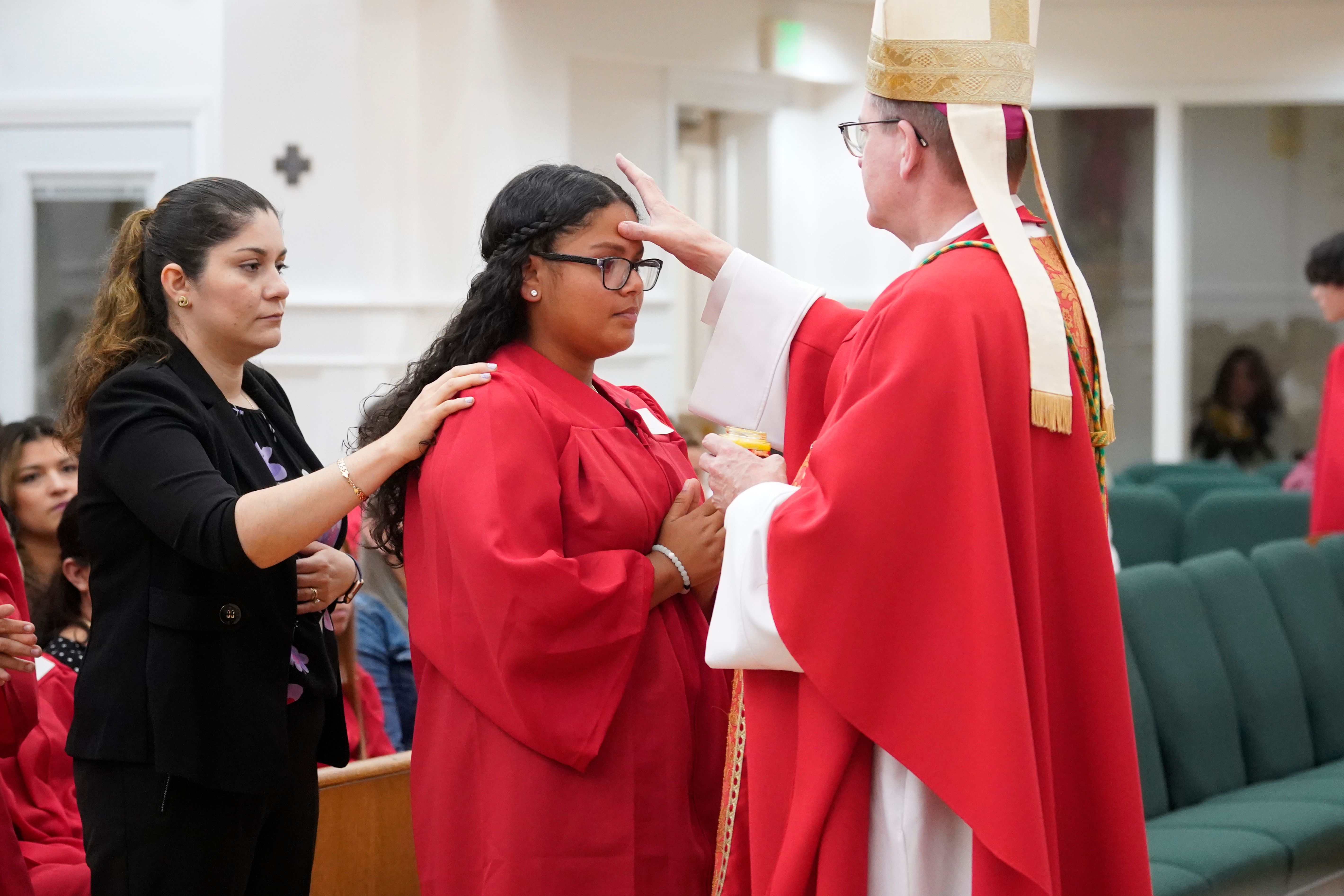
THE SACRAMENT OF CONFIRMATION IN THE CATECHISM OF THE CATHOLIC CHURCH
THE SACRAMENT OF CONFIRMATION
1285 Baptism, the Eucharist, and the sacrament of Confirmation together constitute the "sacraments of Christian initiation," whose unity must be safeguarded. It must be explained to the faithful that the reception of the sacrament of Confirmation is necessary for the completion of baptismal grace. [Cf. Roman Ritual, Rite of Confirmation (OC), Introduction 1.] For "by the sacrament of Confirmation, [the baptized] are more perfectly bound to the Church and are enriched with a special strength of the Holy Spirit. Hence they are, as true witnesses of Christ, more strictly obliged to spread and defend the faith by word and deed." [LG 11; Cf. OC, Introduction 2]
I. CONFIRMATION IN THE ECONOMY OF SALVATION
1286 In the Old Testament the prophets announced that the Spirit of the Lord would rest on the hoped-for Messiah for his saving mission. [Cf. Isa 11:2; 61:1; Lk 4:16-22] The descent of the Holy Spirit on Jesus at his baptism by John was the sign that this was he who was to come, the Messiah, the Son of God. [Cf. Mt 3:13-17; Jn 1:33-34] He was conceived of the Holy Spirit; his whole life and his whole mission are carried out in total communion with the Holy Spirit whom the Father gives him "without measure." [Jn 3:34] [702-716]
1287 This fullness of the Spirit was not to remain uniquely the Messiah's, but was to be communicated to the whole messianic people. [Cf. Ezek 36:25-27; Joel 3:1-2] On several occasions Christ promised this outpouring of the Spirit, [Cf. Lk 12:12; Jn 3:5-8; 7:37-39; 16:7-15; Acts 1:8] a promise which he fulfilled first on Easter Sunday and then more strikingly at Pentecost. [Cf. Jn 20:22; Acts 2:1-14] Filled with the Holy Spirit the apostles began to proclaim "the mighty works of God," and Peter declared this outpouring of the Spirit to be the sign of the messianic age. [Acts 2:11; Cf. 2:17-18] Those who believed in the apostolic preaching and were baptized received the gift of the Holy Spirit in their turn. [Cf. Acts 2:38] [739]
1288 "From that time on the apostles, in fulfillment of Christ's will, imparted to the newly baptized by the laying on of hands the gift of the Spirit that completes the grace of Baptism. For this reason in the Letter to the Hebrews the doctrine concerning Baptism and the laying on of hands is listed among the first elements of Christian instruction. The imposition of hands is rightly recognized by the Catholic tradition as the origin of the sacrament of Confirmation, which in a certain way perpetuates the grace of Pentecost in the Church." [Paul VI, Divinae consortium naturae, 659; Cf. Acts 8:15-17; 19:5-6; Heb 6:2] [699]
1289 Very early, the better to signify the gift of the Holy Spirit, an anointing with perfumed oil (chrism) was added to the laying on of hands. This anointing highlights the name "Christian," which means "anointed" and derives from that of Christ himself whom God "anointed with the Holy Spirit." [Acts 10:38] This rite of anointing has continued ever since, in both East and West. For this reason the Eastern Churches call this sacrament Chrismation, anointing with chrism, or myron which means "chrism." In the West, the term Confirmation suggests that this sacrament both confirms baptism and strengthens baptismal grace. [695, 436, 1297]
EL SACRAMENTO DE LA CONFIRMACIÓN EN EL CATECISMO DE LA IGLESIA CATÓLICA
EL SACRAMENTO DE LA CONFIRMACIÓN
1285 Con el Bautismo y la Eucaristía, el sacramento de la Confirmación constituye el conjunto de los "sacramentos de la iniciación cristiana", cuya unidad debe ser salvaguardada. Es preciso, pues, explicar a los fieles que la recepción de este sacramento es necesaria para la plenitud de la gracia bautismal (cf Ritual de la Confirmación, Prenotandos 1). En efecto, a los bautizados "el sacramento de la Confirmación los une más íntimamente a la Iglesia y los enriquece con una fortaleza especial del Espíritu Santo. De esta forma quedan obligados aún más, como auténticos testigos de Cristo, a extender y defender la fe con sus palabras y sus obras" (LG 11; cf Ritual de la Confirmación, Prenotandos 2):
I. La Confirmación en la Economía de la salvación
1286 En el Antiguo Testamento, los profetas anunciaron que el Espíritu del Señor reposaría sobre el Mesías esperado (cf. Is 11,2) para realizar su misión salvífica (cf Lc 4,16-22; Is 61,1). El descenso del Espíritu Santo sobre Jesús en su Bautismo por Juan fue el signo de que Él era el que debía venir, el Mesías, el Hijo de Dios (Mt 3,13-17; Jn 1,33- 34). Habiendo sido concedido por obra del Espíritu Santo, toda su vida y toda su misión se realizan en una comunión total con el Espíritu Santo que el Padre le da "sin medida" (Jn 3,34).
1287 Ahora bien, esta plenitud del Espíritu no debía permanecer únicamente en el Mesías, sino que debía ser comunicada a todo el pueblo mesiánico (cf Ez 36,25-27; Jl 3,1-2). En repetidas ocasiones Cristo prometió esta efusión del Espíritu (cf Lc 12,12; Jn 3,5-8; 7,37-39; 16,7-15; Hch 1,8), promesa que realizó primero el día de Pascua (Jn 20,22) y luego, de manera más manifiesta el día de Pentecostés (cf Hch 2,1-4). Llenos del Espíritu Santo, los Apóstoles comienzan a proclamar "las maravillas de Dios" (Hch 2,11) y Pedro declara que esta efusión del Espíritu es el signo de los tiempos mesiánicos (cf Hch 2, 17-18). Los que creyeron en la predicación apostólica y se hicieron bautizar, recibieron a su vez el don del Espíritu Santo (cf Hch 2,38).
1288 "Desde [...] aquel tiempo, los Apóstoles, en cumplimiento de la voluntad de Cristo, comunicaban a los neófitos, mediante la imposición de las manos, el don del Espíritu Santo, destinado a completar la gracia del Bautismo (cf Hch 8,15-17; 19,5-6). Esto explica por qué en la carta a los Hebreos se recuerda, entre los primeros elementos de la formación cristiana, la doctrina del Bautismo y de la la imposición de las manos (cf Hb 6,2). Es esta imposición de las manos la que ha sido con toda razón considerada por la tradición católica como el primitivo origen del sacramento de la Confirmación, el cual perpetúa, en cierto modo, en la Iglesia, la gracia de Pentecostés" (Pablo VI, Const. apost. Divinae consortium naturae).
1289 Muy pronto, para mejor significar el don del Espíritu Santo, se añadió a la imposición de las manos una unción con óleo perfumado (crisma). Esta unción ilustra el nombre de "cristiano" que significa "ungido" y que tiene su origen en el nombre de Cristo, al que "Dios ungió con el Espíritu Santo" (Hch 10,38). Y este rito de la unción existe hasta nuestros días tanto en Oriente como en Occidente. Por eso, en Oriente se llama a este sacramento crismación, unción con el crisma, o myron, que significa "crisma". En Occidente el nombre de Confirmación sugiere que este sacramento al mismo tiempo confirma el Bautismo y robustece la gracia bautismal.