
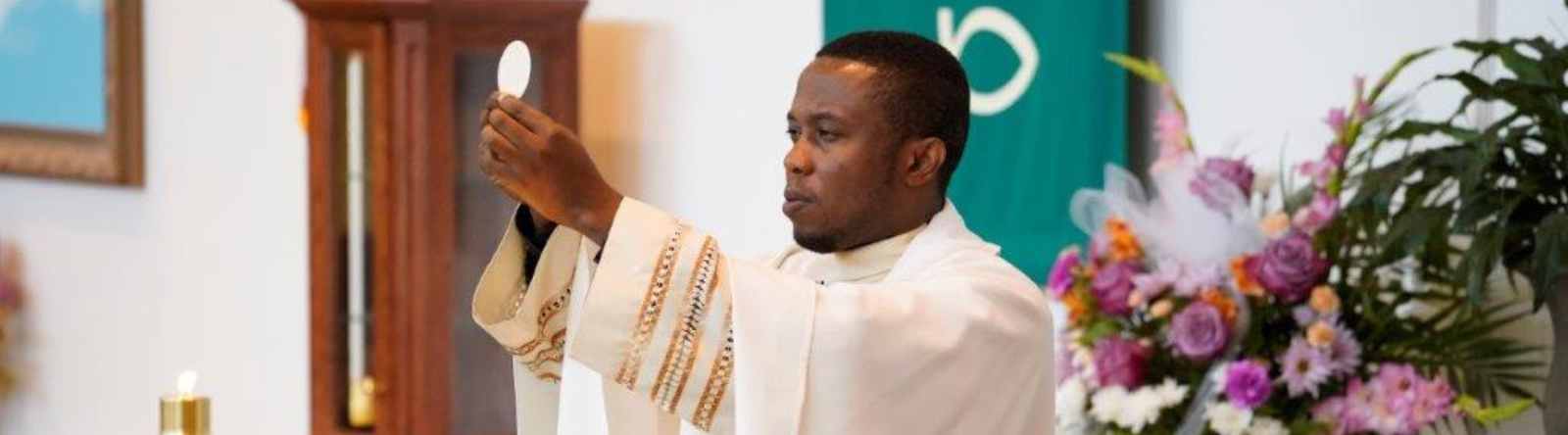

The Sacrament of the Holy Eucharist is the source and summit of the Christian life. The other sacraments, and other ministries and works of Catholic people, are bound together and oriented toward the Holy Eucharist.
El Vaticano Segundo nos describe la Santa Eucaristía como "la fuente y plenitud de la vida cristiana". Todos los otros sacramentos, los ministerios y servicios de los católicos estan unidos y orientados hacia la celebracios de la Santa Eucaristía.

At Mass, the bread and wine are changed into the total Jesus Christ, body and blood, soul and divinity. Holy Communion unites us intimately with Jesus Christ, separates us from sin, and unites with other members of the Catholic Church. Catholics normally receive the Holy Eucharist at Mass unless they need to go to Reconciliation to seek forgiveness of their serious sins.
En la misa, el pan y el vino son tansformados en el cuerpo y la sangre de Jesucristo, presencia real, alma y divinidad. La sagrada comunión nos une a Jesus y nos separa del pecado. También nos une con todos los miembros de la Iglesia Católica. Los católicos practicantes reciben la comunion en todos las misas al no ser que necesiten ir a la confesión para obterner el perdon de sus pecados.
THE SACRAMENT OF THE EUCHARIST IN THE CATECHISM OF THE CATHOLIC CHURCH
THE SACRAMENT OF THE EUCHARIST
1322 The holy Eucharist completes Christian initiation. Those who have been raised to the dignity of the royal priesthood by Baptism and configured more deeply to Christ by Confirmation participate with the whole community in the Lord's own sacrifice by means of the Eucharist.
1323 "At the Last Supper, on the night he was betrayed, our Savior instituted the Eucharistic sacrifice of his Body and Blood. This he did in order to perpetuate the sacrifice of the cross throughout the ages until he should come again, and so to entrust to his beloved Spouse, the Church, a memorial of his death and resurrection: a sacrament of love, a sign of unity, a bond of charity, a Paschal banquet 'in which Christ is consumed, the mind is filled with grace, and a pledge of future glory is given to us.'" 135
I. THE EUCHARIST - SOURCE AND SUMMIT OF ECCLESIAL LIFE
1324 The Eucharist is "the source and summit of the Christian life." 136 "The other sacraments, and indeed all ecclesiastical ministries and works of the apostolate, are bound up with the Eucharist and are oriented toward it. For in the blessed Eucharist is contained the whole spiritual good of the Church, namely Christ himself, our Pasch." 137
1325 "The Eucharist is the efficacious sign and sublime cause of that communion in the divine life and that unity of the People of God by which the Church is kept in being. It is the culmination both of God's action sanctifying the world in Christ and of the worship men offer to Christ and through him to the Father in the Holy Spirit." 138
1326 Finally, by the Eucharistic celebration we already unite ourselves with the heavenly liturgy and anticipate eternal life, when God will be all in all. 139
1327 In brief, the Eucharist is the sum and summary of our faith: "Our way of thinking is attuned to the Eucharist, and the Eucharist in turn confirms our way of thinking." 140
II. WHAT IS THIS SACRAMENT CALLED?
1328 The inexhaustible richness of this sacrament is expressed in the different names we give it. Each name evokes certain aspects of it. It is called:
Eucharist, because it is an action of thanksgiving to God. The Greek words eucharistein 141 and eulogein 142 recall the Jewish blessings that proclaim - especially during a meal - God's works: creation, redemption, and sanctification.
1329 The Lord's Supper, because of its connection with the supper which the Lord took with his disciples on the eve of his Passion and because it anticipates the wedding feast of the Lamb in the heavenly Jerusalem. 143
The Breaking of Bread , because Jesus used this rite, part of a Jewish meal, when as master of the table he blessed and distributed the bread, 144 above all at the Last Supper. 145 It is by this action that his disciples will recognize him after his Resurrection, 146 and it is this expression that the first Christians will use to designate their Eucharistic assemblies; 147 by doing so they signified that all who eat the one broken bread, Christ, enter into communion with him and form but one body in him. 148
The Eucharistic assembly (synaxis) , because the Eucharist is celebrated amid the assembly of the faithful, the visible expression of the Church. 149
1330 The memorial of the Lord's Passion and Resurrection.
The Holy Sacrifice , because it makes present the one sacrifice of Christ the Savior and includes the Church's offering. The terms holy sacrifice of the Mass, "sacrifice of praise," spiritual sacrifice, pure and holy sacrifice are also used, 150 since it completes and surpasses all the sacrifices of the Old Covenant.
The Holy and Divine Liturgy , because the Church's whole liturgy finds its center and most intense expression in the celebration of this sacrament; in the same sense we also call its celebration the Sacred Mysteries . We speak of the Most Blessed Sacrament because it is the Sacrament of sacraments. The Eucharistic species reserved in the tabernacle are designated by this same name.
1331 Holy Communion , because by this sacrament we unite ourselves to Christ, who makes us sharers in his Body and Blood to form a single body. 151 We also call it: the holy things (ta hagia; sancta) 152 - the first meaning of the phrase "communion of saints" in the Apostles' Creed - the bread of angels, bread from heaven, medicine of immortality, 153 viaticum . . . .
1332 Holy Mass (Missa) , because the liturgy in which the mystery of salvation is accomplished concludes with the sending forth ( missio ) of the faithful, so that they may fulfill God's will in their daily lives.
EL SACRAMENTO DE LA EUCARISTÍA EN EL CATECISMO DE LA IGLESIA CATÓLICA
EL SACRAMENTO DE LA EUCARISTÍA
1322 La Sagrada Eucaristía culmina la iniciación cristiana. Los que han sido elevados a la dignidad del sacerdocio real por el Bautismo y configurados más profundamente con Cristo por la Confirmación, participan por medio de la Eucaristía con toda la comunidad en el sacrificio mismo del Señor.
1323 "Nuestro Salvador, en la última Cena, la noche en que fue entregado, instituyó el Sacrificio Eucarístico de su cuerpo y su sangre para perpetuar por los siglos, hasta su vuelta, el sacrificio de la cruz y confiar así a su Esposa amada, la Iglesia, el memorial de su muerte y resurrección, sacramento de piedad, signo de unidad, vínculo de amor, banquete pascual en el que se recibe a Cristo, el alma se llena de gracia y se nos da una prenda de la gloria futura" (SC 47).
I. La Eucaristía, fuente y culmen de la vida eclesial
1324 La Eucaristía es "fuente y culmen de toda la vida cristiana" (LG 11). "Los demás sacramentos, como también todos los ministerios eclesiales y las obras de apostolado, están unidos a la Eucaristía y a ella se ordenan. La sagrada Eucaristía, en efecto, contiene todo el bien espiritual de la Iglesia, es decir, Cristo mismo, nuestra Pascua" (PO 5).
1325 "La comunión de vida divina y la unidad del Pueblo de Dios, sobre los que la propia Iglesia subsiste, se significan adecuadamente y se realizan de manera admirable en la Eucaristía. En ella se encuentra a la vez la cumbre de la acción por la que, en Cristo, Dios santifica al mundo, y del culto que en el Espíritu Santo los hombres dan a Cristo y por él al Padre" (Instr. Eucharisticum mysterium, 6).
1326 Finalmente, por la celebración eucarística nos unimos ya a la liturgia del cielo y anticipamos la vida eterna cuando Dios será todo en todos (cf 1 Co 15,28).
1327 En resumen, la Eucaristía es el compendio y la suma de nuestra fe: "Nuestra manera de pensar armoniza con la Eucaristía, y a su vez la Eucaristía confirma nuestra manera de pensar" (San Ireneo de Lyon, Adversus haereses 4, 18, 5).
II. El nombre de este sacramento
1328 La riqueza inagotable de este sacramento se expresa mediante los distintos nombres que se le da. Cada uno de estos nombres evoca alguno de sus aspectos. Se le llama:
Eucaristía porque es acción de gracias a Dios. Las palabras eucharistein (Lc 22,19; 1 Co 11,24) y eulogein (Mt 26,26; Mc 14,22) recuerdan las bendiciones judías que proclaman —sobre todo durante la comida— las obras de Dios: la creación, la redención y la santificación.
1329 Banquete del Señor (cf 1 Co 11,20) porque se trata de la Cena que el Señor celebró con sus discípulos la víspera de su pasión y de la anticipación del banquete de bodas del Cordero (cf Ap 19,9) en la Jerusalén celestial.
Fracción del pan porque este rito, propio del banquete judío, fue utilizado por Jesús cuando bendecía y distribuía el pan como cabeza de familia (cf Mt 14,19; 15,36; Mc 8,6.19), sobre todo en la última Cena (cf Mt 26,26; 1 Co 11,24). En este gesto los discípulos lo reconocerán después de su resurrección (Lc 24,13-35), y con esta expresión los primeros cristianos designaron sus asambleas eucarísticas (cf Hch 2,42.46; 20,7.11). Con él se quiere significar que todos los que comen de este único pan, partido, que es Cristo, entran en comunión con él y forman un solo cuerpo en él (cf 1 Co 10,16-17).
Asamblea eucarística (synaxis), porque la Eucaristía es celebrada en la asamblea de los fieles, expresión visible de la Iglesia (cf 1 Co 11,17-34).
1330 Memorial de la pasión y de la resurrección del Señor.
Santo Sacrificio, porque actualiza el único sacrificio de Cristo Salvador e incluye la ofrenda de la Iglesia; o también Santo Sacrificio de la Misa, "sacrificio de alabanza" (Hch 13,15; cf Sal 116, 13.17), sacrificio espiritual (cf 1 P 2,5), sacrificio puro (cf Ml 1,11) y santo, puesto que completa y supera todos los sacrificios de la Antigua Alianza.
Santa y divina liturgia, porque toda la liturgia de la Iglesia encuentra su centro y su expresión más densa en la celebración de este sacramento; en el mismo sentido se la llama también celebración de los santos misterios. Se habla también del Santísimo Sacramento porque es el Sacramento de los Sacramentos. Con este nombre se designan las especies eucarísticas guardadas en el sagrario.
1331 Comunión, porque por este sacramento nos unimos a Cristo que nos hace partícipes de su Cuerpo y de su Sangre para formar un solo cuerpo (cf 1 Co 10,16-17); se la llama también las cosas santas [ta hagia; sancta] (Constitutiones apostolicae 8, 13, 12; Didaché 9,5; 10,6) —es el sentido primero de la "comunión de los santos" de que habla el Símbolo de los Apóstoles—, pan de los ángeles, pan del cielo, medicina de inmortalidad (San Ignacio de Antioquía, Epistula ad Ephsios, 20,2), viático...
1332 Santa Misa porque la liturgia en la que se realiza el misterio de salvación se termina con el envío de los fieles ("missio") a fin de que cumplan la voluntad de Dios en su vida cotidiana.